
Preserving the Legacy of Lorraine “Grandma” Camacho
BY MARISEL SAUCEDO-TARIN
This article appeared in Preservation Austin's Spring 2026 newsletter. Join or renew as a member to receive future issues straight to your door!

Lorraine Camacho pictured in “Extraordinary Camacho Personifies Volunteerism,” Austin American-Statesman, September 22, 1991.
Women have played a pivotal role in shaping the vibrant Austin we know today. These remarkable advocates, often working behind the scenes, laid the foundation for the city’s growth and cultural diversity through their dedication to education, community service, and social justice.
One such woman was “Grandma” Camacho. This incomparable figure was born Lorraine Castro in Austin in 1917 to a well-respected family whose roots in the city dated back to the 1870s. Like many Tejanos of the time, she was pulled out of school to help her family pick cotton to make ends meet. She married her husband Daniel Camacho in 1940, and in 1945 Daniel built their East Austin home at 2210 Canterbury Street, using scrap materials collected from various carpentry jobs around Austin, including red carpet salvaged from the renovation of the Driskill Hotel. They would live here with their four children for the next half century.
Like her own parents, Lorraine and Daniel became valued members of their community. Lorraine was an active PTA member and worked with the Austin Independent School District at both Metz Elementary School, next to her Canterbury Street home, and Zavala Elementary School. After retiring in 1979, she remained a devoted volunteer at Metz Elementary, where she continued to support faculty, staff, and especially students.
Their home on Canterbury Street became a gathering place for Austin’s emerging politicians. The cozy living room was the setting for a meet-and-greet event during Gonzalo Barrientos' State Representative campaign in 1972. Barrientos understood that to secure local votes, he needed to gain the support of East Austin’s most influential residents—like the Camacho family. The Camachos had deeply embedded their legacy into the fabric of East Austin through social activism, civil rights advocacy, and a strong commitment to education. Many local and state politicians, including Richard Moya, John Treviño, Wilhelmina Delco, and Lloyd Doggett, sought their guidance and support on community matters over the years. [1]
Lorraine’s small East Austin neighborhood was her village, where she was surrounded by her people—her extended family. It’s no wonder that she was so dedicated to the future generations of East Austinites. Her warm, sociable nature made her a comforting presence for many families, and the neighborhood children affectionately called her “Grandma Camacho.” She was committed to ensuring that her neighbors could raise their children in a safe environment, where kids could walk to Metz Park and play among familiar faces. Lorraine was a staunch advocate for education, community improvement, and solutions to drug and crime problems. In a 1996 Austin American-Statesman interview she famously advised, “always think about the younger generation that’s coming ahead of you.” [2]
Austin’s 1928 City Plan institutionalized racial segregation by creating a “Negro District” in what is now East Austin. The plan was designed to keep Black residents concentrated in this area, segregating the city under the guise of “streamlining” the costs of maintaining separate schools and facilities for different races. Despite these discriminatory policies, East Austin residents including its Mexican American community came together to build vibrant, tight-knit communities. They established businesses, homes, schools, and churches, attracting teachers, doctors, and political figures. The area thrived with its growing middle- and working-class families, providing a sense of safety and belonging during a time of racial tensions.
The "Mayberry-esque" charm of East Austin began to change with the enforcement of the Fair Housing Act of 1968, which initiated the desegregation of the city. The 1971 closure of L.C. Anderson High School, Austin’s only Black high school, due to forced integration marked a significant upheaval. The refusal to bus white students to a Black school and subsequent need for Black students to be bused to predominantly white schools led to a migration of middle-class families from the area. This disruption caused businesses to close, buildings to become vacant, and the sense of community to erode.

Angela Shah, “Metz Volunteer was ‘Grandma’ to Pupils,” Austin American-Statesman, December 31, 1999.
In the 1980s, crack cocaine spread throughout Austin, yet law enforcement efforts focused largely on the East Side, even though the drug was present across the city, including in white communities. This uneven focus shaped lasting disparities in policing and community impact. [3] These enforcement patterns, in turn, led to the incarceration of many men of color, leaving youth to resort to drug dealing as a survival strategy, and contributing to an overall rise in gangs, violence, and drug and alcohol abuse in the area. The East Austin community united to combat this crisis, working tirelessly to create after-school programs and drug- and alcohol-free zones around local parks and raise awareness among city officials, police officers, teachers, and journalists.
Lorraine was a prominent figure in these efforts to advocate and improve conditions for future generations. A living example of the adage "it takes a village," she transformed her Canterbury Street home into a sanctuary for neighborhood children, offering a refuge from the changing and often unsafe environment. She made the safe haven status official in 1995 by adding her home to the “McGruff the Crime Dog” safe house program, developed by the National Crime Prevention Council (NCPC) and the Ad Council the decade before to protect children from neighborhood crime. [4]
The haven provided by her home and the numerous awards bestowed on Lorraine during her lifetime are a testament to her legacy of community care. Lorraine was honored with the Austin Light’s Neighborhood Mom Award in 1990, the Austin ISD Volunteer of the Year Award in 1991 (shared with her daughter Darlene), the Fiestas Patrias award in 1991, the Mexican American Business and Professional Women’s Association (MABPWA) Lifetime Award in Education and Community Service in 1993, and the Austin ISD Hispanic Heritage Community Service Award in 1996. Additionally, Austin Mayor Bruce Todd proclaimed September 15, 1991, as “Lorraine Camacho Day.”
Lorraine passed away in Austin on December 29, 1999. In 2000, following her 50 years of dedicated community activism, Austin City Council named the newly built 7,500-square-foot activity center located at Bergman Avenue and Robert Martinez Street in her honor. The Lorraine “Grandma” Castro Camacho Center serves the East Austin community, providing specialized educational and recreational programs for youth and adult residents.
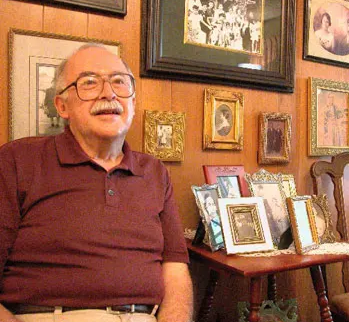
Danny Camacho pictured in Tony Cantu, “Cafeteria Worker Turned Noted Local Historian Danny Camacho Documented East Austin History,” Patch, April 29, 2016.
Lorraine’s only son, inspired by his mother’s devotion to her neighborhood, made it his mission to preserve Austin’s Mexican-American history. Danny grew up in pre-gentrified East Austin, and continued to live in his parents’ home after their death. Seeing the landscape change around him, he didn’t want old East Austin’s vibrant past to disappear. He dedicated his time to sharing stories of his diverse neighborhood, served as a founding member of Save Austin’s Cemeteries, and became known as one of Austin’s local historians through his comprehensive research at the Austin History Center, where, thanks to his efforts, the Camacho family’s contributions to the city are preserved in 13 boxes.
The Camachos were part of an East Austin that provided a tight-knit community of friends and families with shared culture and tradition; where neighbors ensured that local kids could grow up slowly, despite the breakdown of the city around them; where locally owned businesses thrived and people looked out for each other. But this community culture is disappearing as those who experienced old East Austin have passed away or moved because of rapid gentrification in the area. Danny Camacho’s death in 2016 seemingly coincided with this shift: his family home was put up for sale in 2017 and sold in 2018 with a listing price of $450,000. The home was demolished to make way for a modern, two-unit condominium. East Austin’s Holly neighborhood, in which Camacho solidified her legacy, has transitioned into one of Time Out’s “50 Coolest Neighborhoods in the World” with a median home price of $687,150 as of 2024 and a slew of new restaurants and businesses tailored to high-income residents flocking to Austin thanks to the city’s tech business boom since the early aughts. [5] As a result increasing property taxes are driving out original working-class East Austin residents and the culture they established over a century.
In 2016 the City of Austin commissioned the East Austin Historic Resource Survey to identify potential historic landmarks and districts in the area, but the bungalow at 2210 Canterbury Street was reported not eligible for designation at the national nor local level. The City of Austin’s criteria for individual properties to be eligible for local designation requires a property to be “50 years old, retain integrity, and have a previous designation OR demonstrate significance in two of the following: architecture, association with significant people/groups/events, archaeology, community value, and landscape features”—but survey protocol at the time only involved occupancy research for buildings deemed as architecturally significant, undermining the latter criteria.
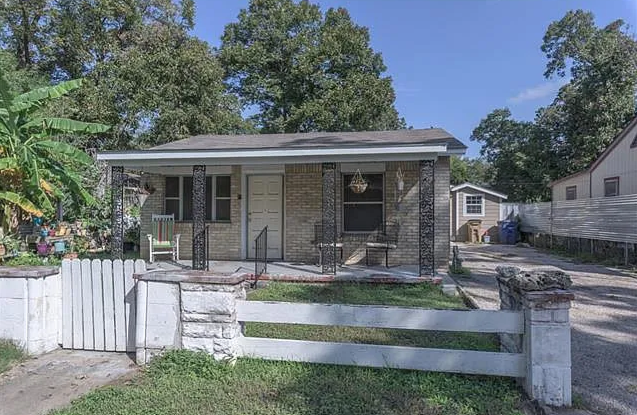
Camacho Residence, Zillow, 2024.
The 75-year-old Camacho residence was likely deemed lacking in architectural significance, and as a result the unquestionable significance of its occupants and role in the community was overlooked. In a vastly middle- and working-class area like East Austin, where modest homes and businesses and the people who tended to them made up the heart of the community, this emphasis on architectural significance is highly problematic. While the characteristics deemed architecturally significant are well-established in professional circles, the more subjective qualities of cultural significance and community value require more work to establish—work that tends to fall on the shoulders of the community residents rather than the city.
If the Camacho family never sought historic designation, it may have been out of concern that designation could lead to increased property taxes for surrounding homes, potentially forcing neighbors to sell and accelerating gentrification. However, it could be argued that the construction of a modern duplex would have the same effect. Intimidation by the designation process”—or a lack of familiarity with it or time to pursue it”—may have been a barrier as well. Beyond the work of preparing the application for historic review and documenting the property’s significance, the review process can involve a public hearing—a step that can be met with contention if the application is not initiated until after a proposed demolition. Another possible reason is general distrust in city processes—common among East Austin residents given the city’s history of segregation–leading to a reluctance to participate or take initiative in historic review processes.
This is the same complex set of reasons for why we see similar East Austin properties lose battles against redevelopment. According to the late JuanRaymon Rubio, a former associate at Architexas and Preservation Austin board member, preservation advocates from the Latino community are spread thin: “We often lose buildings because no one comes out to speak for them—or just one person does, every time. Preservation is hyperlocal: commissioners and city council will perk up more if dozens if not hundreds of citizens go to bat for a property.” Rubio noted that while Austin is home to a strong group of Latino political activists, preservation is not their priority. Building a pipeline for diversity among preservation activists, city staff, and commission representatives is one possible strategy for preventing underrepresented heritage from being overlooked. [6]
Austin’s Equity-Based Preservation Plan, adopted unanimously by City Council in November 2024, seeks to address these barriers by offering new models for empowering diverse community engagement. The plan, which replaced the city’s last preservation plan adopted nearly 45 years before, was “built on an inclusive, equity-focused, and community-oriented framework,” emphasizing the preservation of properties in underserved communities, including redeveloped neighborhoods like those in East Austin. According to a press release, the plan and its recommendations take a “proactive and strategic approach, recommending more community engagement and up-front information-gathering…to better tell Austin’s full, complex story while maintaining a high bar for historic designation.” [7]
As this forward-looking preservation plan is put into action, it is imperative that we do our part by engaging in preservation advocacy, storytelling, and designation processes. As community members like Grandma Camacho who were central to Austin’s culture pass on or are displaced, the echoes of their vibrant lives are left within the walls of buildings that now need care and attention. Preservation is not merely about maintaining these physical structures but about honoring the legacy and contributions of those who inhabited them. By safeguarding their stories through tangible reminders in the urban fabric, we can ensure that Austin remains a vibrant and inclusive city, reflective of its rich and multifaceted history.
Notes
Jason Spencer, “Prominent Hispanic had Local Clout,” Austin American-Statesman, July 13, 2001, https://www.newspapers.com/article/austin-american-statesman/112579210/.
Andy Alford, “East Austin center named for ‘Grandma’,” Austin American-Statesman, September 8, 2000.
Mose Buchele, “Old Friends Remember Good Times, Trouble And The East Austin They Lost,” KUT News, March 23, 2017, https://www.kut.org/austin/2017-03-23/old-friends-remember-good-times-trouble-and-the-east-austin-they-lost.
Christian Cruz, “Lorraine Castro Camacho,” Handbook of Texas Online, February 27, 2018, https://www.tshaonline.org/handbook/entries/camacho-lorraine-castro.
Madeline Hollern and Saba Rahimian, “The 8 Hottest Neighborhoods in Austin: Holly,” Austin Monthly, March/April 2024, https://www.austinmonthly.com/the-8-hottest-neighborhoods-in-austin-holly/; Joey Hadden, “Inside Holly, Austin's 'Coolest Neighborhood' that's Sparking a Huge Debate About Gentrification,” Business Insider, January 13, 2020, https://www.businessinsider.com/photos-east-austin-cooleast-neighborhood-changed-gentrification-holly-2019-11.
JuanRaymon Rubio, email message to author, May 20, 2024.
City of Austin, “Draft Equity-Based Preservation Plan Released for Community Review,” press release, February 6, 2024, https://www.austintexas.gov/news/draft-equity-based-preservation-plan-released-community-review.
Marisel Saucedo-Tarin was Preservation Austin’s 2024 Women’s Heritage Intern. As a former student and high school social studies teacher of Austin ISD, Marisel remains a strong advocate for the betterment of education. As a child of the 1990s, she recalls programs like McGruff the Crime Dog and D.A.R.E. being implemented at her school and across other Austin ISD campuses, embedding crime prevention and drug education initiatives in classrooms throughout the city. Funding for Preservation Austin’s 2024 Women’s Heritage Internship was provided by the Historic Preservation Office in Austin Planning. The views expressed here do not necessarily reflect the policies or positions of the City of Austin.